A representative from Calyos will reach out to you to plan an introductory web call where they will explain how our technology works and demonstrate the applications and benefits of it.
Thank you! Your submission has been received!
Oops! Something went wrong while submitting the form. Please try again.
The AI genAIRation | Part 1: Taking Air-Cooled AI Servers to the Next Level
Location:
Charleroi, Belgium
DATE:
August 10, 2026
Air cooling is hitting its limit in AI servers. Here is where it falls short, and how passive two-phase cooling extends what air can do.
"Air has reached its limits"
This emblematic phrase is now echoing across the entire IT cooling industry.
For years, air cooling was the industry default. It’s cheap, modular and easy to implement in traditional air cooled data centers. This gives IT operators a high level of implementation flexibility and thermal autonomy. Today, hyperscalers are rapidly shifting to liquid cooling to handle the extreme rack densities of AI and HPC workloads.
But where does that leave everyone else?
Enterprises, air-cooled data centers and edge operators face a dilemma: many of them desire AI computing, but liquid cooling introduces investment, complex new infrastructure and new critical cooling components not present before.
Operators deserve ultimate flexibility in deployment types. Choice of liquid or air.
This article presents where, exactly, does air fall short and how Calyos can help to address this problem without rebuilding everything.
"Air has reached its limits"…but where?
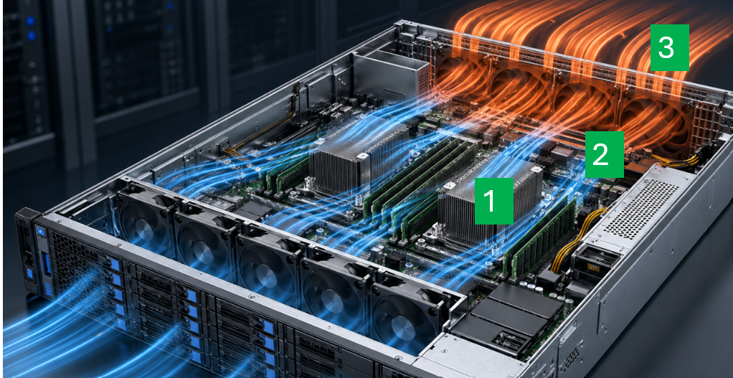
The cooling process inside a server can be broken into three distinct steps:
Heat absorption (extracting heat from the processor)
Heat transport (moving heat from the processor to the server perimeter)
Heat rejection (releasing heat out of the server)
In traditional servers, air manages all three. See picture below:
When air-cooled servers (that can be assisted by vapor chambers and standard heat pipes) implement high TDP processors , maintaining an acceptable chip temperature becomes challenging :
at heat absorption : the capacity of air to receive the heat load remains too low due to its poor convective thermal coefficient
at heat transport : air volumetric heat capacity remains too poor to transport the heat
In order to accommodate air cooled servers for AI GPUs, engineers have to drastically increase both:
the size
and the airflow rate of their servers.
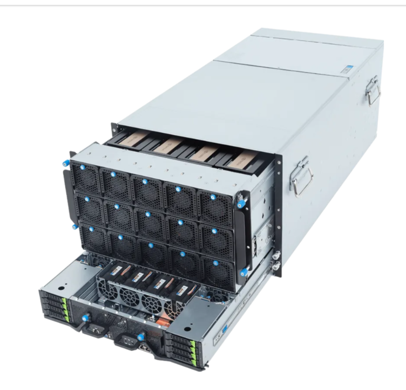
This is illustrated by the air-cooled HGX B300 server platforms available today from Dell, Cisco, Supermicro, Lenovo, and other vendors.
The HGXB300 air-cooled solution presents up to 15 fans and a height up to 8U for the GPU tray.
But this solution comes with two design trade-offs:
Large chassis volume : Server form factor is an important criterion in the IT industry. The larger the server, the more rack space it occupies, and increase the IT room space requirements.
High fan count : Fans are moving components, and their power consumption increases roughly with the cube of the required airflow rate. This impacts operational costs as well as the acoustic noise levels.
One way to address these challenges is to identify a more effective medium than air for heat absorption and heat transport.
From Heat Pipes and Vapor chambers to the Loop Heat Pipe
Calyos' technology allows us to build on the foundation from heat pipes and vapor chambers and take this to the next level. By leveraging the HTC of 2-phase in a simple, passive, closed loop system, there are opportunities to enable either:
1. higher power GPUs for air cooled systems
2. smaller systems for current GPUs.
This enables a new generation of air-cooled AI infrastructure, combining higher compute density with improved thermal efficiency.
Partner with Calyos for AI server Cooling
Calyos is actively developing and deploying advanced cooling solutions for server and racks applications. We are working with industry leaders to ensure the new generation of AI servers operates with greater efficiency, reliability, and sustainability.
If you are designing AI servers , or tackling thermal management challenges in data center applications, we want to hear from you. Let’s work together to create robust, maintenance-free cooling solutions that push the boundaries of performance and reliability.
Any question? Contact our technical team : info@calyos-tm.com
Who We Are Calyos is a leader in the design and manufacture of two-phase thermal management systems. Building on our heritage from Euro Heat Pipes (EHP) and their space technology expertise, we specialize in innovative cooling solutions that tackle the thermal challenges of tomorrow. What We Do We engineer advanced cooling technologies, including loop heat pipes, micro-channel heat pipes, and pulsating heat pipes, to optimize thermal performance across a variety of applications. Typically these include: power electronics, processors, and batteries, but we don't stop there we are continuing to develop and produce fully customizable solutions for other specific needs, for example e-motors and fuel cells. Where We Operate Calyos is headquartered in Charleroi, Belgium, where our engineering and production teams work side by side in a state-of-the-art facility. From this base, we serve a global clientele, providing our cutting-edge solutions across North America, Asia, Europe, and South America. When We Started Calyos was incorporated in 2014 as a spin-off from Euro Heat Pipes (EHP), which was established in 2001 and has become a major player in the European satellite market. Since then, Calyos has been adapting and evolving EHP's space-grade cooling technologies for terrestrial applications. Why We Matter Our mission is to lead the industry towards adopting the most effective and sustainable thermal management solutions. We aim to address the most pressing thermal challenges in the data-driven and electrified environments of today, leveraging passive cooling technologies to achieve superior efficiency and environmental stewardship. How We Succeed Our success is driven by our commitment to four core values: 1. Applied Knowledge - Transforming deep technical expertise into market-ready solutions. 2. Better Together - Emphasizing collaboration with all stakeholders to enhance our collective success. 3. Inherent Flexibility - Adapting our solutions and practices to keep pace with evolving market demands. 4. Continuous Research - Persistently innovating to maintain our leadership in thermal technology.